Mostrando postagens com marcador benchmark. Mostrar todas as postagens

sábado, 28 de setembro de 2013

iPhone 5s Benchmarks Leak on GFXBench

With all the attention the iPhone 5s is getting, it was about time benchmarks of the device were leaked, and the source of the leak is no other than popular graphics benchmark GFXBench. Unfortunately, though, the device information the benchmark results gives us isn't plentiful. 

The device info on GFXBench's website only confirms the resolution (1136 x 640) and the presence of iOS 7, which were both more than known. The GPU name is only shown as "Apple A7 GPU", so there's not much that we can extract from that. However, deductions based on the little info Apple did provide us about the GPU indicate the A7's GPU could be a PowerVR 6 "Rogue" series GPU. 


On the T-Rex HD Offscreen test, the iPhone 5s gets a very good score, surpassing the iPhone 5 with more than 3x the performance (Apple claimed the iPhone 5s was just twice as fast as the iPhone 5 in graphics), and when compared to the Android crowd the iPhone 5s also does really well in this test, slightly surpassing the Nvidia Shield and only kept from the top spot by the Samsung Galaxy S4 with the Snapdragon 800 (GT-I9506). Onscreen T-Rex HD tests show, roughly, a 2.5x increase in performance compared to the iPhone 5, and is above every other Android device except for the Nvidia Shield. 
Moving on to the Egypt HD tests, the Offscreen test gets the iPhone 5s just shy of a 2x increase over the iPhone 5, but it has a lower score than many Adreno 330 and some Tegra 4 devices and actually has a very similar score to the iPad 4. The Onscreen test shows a bit more than a 25% increase over the iPhone 5 and is in line with many Adreno 320 devices which have a slightly higher 720p resolution and is significantly behind the Adreno 330-sporting Galaxy S4 and the Nvidia Shield.


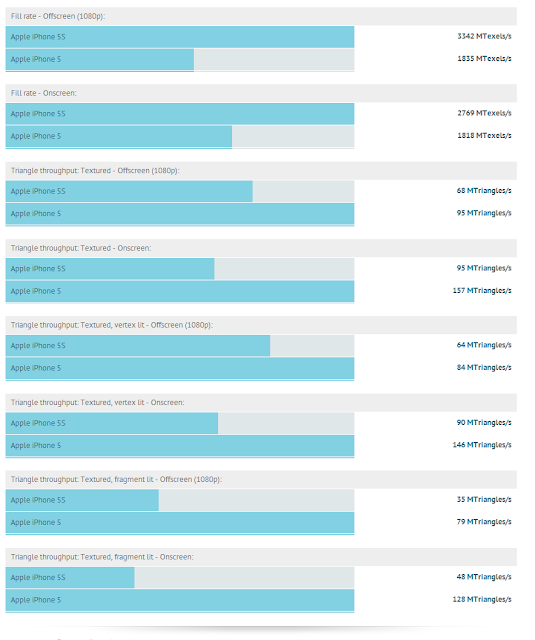
Fill rate, which has always been plentiful in Apple's GPUs, sees an unprecedented score in mobile, outperforming every other mobile device by a huge margin. Although, at the iPhone 5s' low resolution, the gains in fill rate won't be a factor in real-world gaming performance.  Although I'm sure that the impressive fill rate of the Apple A7 will be of benefit to a very high resolution device, like the upcoming iPad 5. 

Interestingly, all of the Triangle Throughput tests get much lower scores than on the iPhone 5, iPad 4 and most PowerVR SGX MP-based Apple devices. If I had to guess, this is due to an architectural difference between that generation of PowerVR GPUs and Rogue. Basically, each module (read: core) of a PowerVR SGX MP GPU is an exact copy of each other, which means that each added module contained their own geometry hardware, so that the MP3 and MP4 (tri-core and quad-core) versions in the iPhone 5 and iPad 3/4 ended up with a lot of geometry compute, hence the insane Triangle Throughput scores these devices achieve. Rogue works differently. Each GPU module adds just shading hardware, so geometry hardware remains constant no matter how many modules you add. While this means Rogue devices will earn less impressive Triangle Throughput scores, it ensures that there'll be no unnecessary amounts of geometry hardware (let's face it, the iPhone 5 and iPad 4 had much more geometry compute than what would ever be necessary for a mobile device). Nevertheless, the iPhone 5s appears to pack enough geometry compute to be competitive with other GPUs. 

Apple appears to have outfitted a very powerful GPU for the iPhone 5s. While this smartphone doesn't take the top spot in most tests, I suppose this will be the job for the upcoming iPad 5. 

segunda-feira, 16 de setembro de 2013

Possible Google Nexus 5 Benchmarks Leak

As the original LG Nexus 4 is growing long in the tooth, a refresh to the Google smartphone is imminent, and GFXBench's database seems to have just confirmed the existence of the Nexus 5 smartphone. The upcoming smartphone has already had a couple of minor leaks: one is about an FCC document referring to an LG smartphone that could be the Nexus 5. The other leak was pretty intentional; the smartphone appeared during a Google promo video introducing Android 4.4 KitKat. Here's what the GFXBench leak reveals:


The device, as expected, is named Google Nexus 5. I find it very strange that the Android version is apparently named Key Lime Pie, even though Google announced officially that the next Android version was to be named KitKat. Also, the SDK version is number 18, but I'd expect it to be 19, since the version 18 refers to Android 4.3. These are reasons to take this leak with a large grain of salt. 

The device runs on a strange screen resolution of 1800 x 1080, which could either indicate Google is going for an unusual aspect ratio, or the different resolution is due to the presence of a navigation bar, which has been present in all Nexus smartphones instead of physical buttons. 

The device runs on a Qualcomm Snapdragon 800 SoC, which features an Adreno 330 GPU  and four Krait 400 cores @ up to 2.3GHz. 


The leak consists of only two benchmarks results. One of them is the rather old GLBenchmark 2.5 Egypt HD Offscreen test, which, as the Adreno 330 implies, yields some very impressive results, although it's not exactly ahead of other Snapdragon 800-bearing devices, but rather on par with them. The other result, the T-Rex HD Offscreen test, also shows some impressive scores, again, on par with most Snapdragon 800-based devices, but slightly behind the Snapdragon 800 Galaxy S4 variant (GT-i9506) and the Nvidia Shield.

While the benchmark results aren't outstanding for a Snapdragon 800 device (this means they are outstanding compared to the rest), it does add to the slowly turning rumor mill about an upcoming LG Nexus 5 smartphone. Like I said though, the Key Lime Pie nomenclature and the odd SDK version number, as well as the strange display resolution doesn't help me gain confidence on this leak, but a 1080p, Snapdragon 800 5-inch Nexus smartphone is almost predictable, so the leak could be legitimate. 

quarta-feira, 4 de setembro de 2013

Microsoft Surface 2 Powered By Tegra 4 Benchmarks Leak

Another unannounced device has just popped up on GFXBench's online database, and this time it's Microsoft's Surface 2 tablet. 


Looks like Microsoft hasn't given up on Windows RT after all, but it doesn't seem like they're putting much effort into it either, as the leaked device has a screen resolution of 1360 x 768 in plain 2013. The device, named Microsoft Surface 2, boasts a very powerful Tegra 4 processor, at least. (Recap: The Tegra 4 consists of four Cortex-A15 cores clocked at up to 1.9GHz and a 72-core GeForce GPU)


There are only two results on the database. One is for the T-Rex HD Offscreen test, which gets a score of 10.6 fps. I certainly hope the performance is being affected by unfinished software, because this score is mediocre compared to other Tegra 4 devices. For comparison, the iPad 4 scores 19.1 fps on the same test, and it's 10 months old!
The other benchmark score is for the Onscreen T-Rex HD test, and that gets a score of 24.4 fps, which is considerably above the iPad 4's 12.7 fps score, but that's just because of the Surface 2's mediocre resolution. 

Take this all with a grain of salt, of course, but if this is really the Surface 2 I can almost guarantee it'll be another flop. 1360 x 768 resolution for a 10.6-inch display (the size of the last-gen Surface, and most probably the Surface 2 too) was acceptable for a high-end device in 2011, but not today. And unless these benchmark scores are justified by unfinished software, then the Surface 2 will be far behind in terms of performance, even compared to other devices powered by the very same SoC. 

Update: The Surface 2 has been officially announced, and the resolution of the device, unlike what the benchmark leak reports, is 1920 x 1080. Also, the Tegra 4 SoC is now officially confirmed, though clocked at a lower 1.7GHz.

terça-feira, 27 de agosto de 2013

ASUS PadFone Infinity with Snapdragon 800 Benchmarks Leak

Many flagship smartphones released during the first half of 2013 were powered by Qualcomm's Snapdragon 600 processor, prior to the release of the much more powerful Snapdragon 800. Instead of waiting one year to release a new flagship to deploy the faster SoC, many OEMs seemed like they couldn't wait to release a Snapdragon 800-bearing flagship. Samsung promptly released an LTE-A capable Galaxy S4 variant with the Snapdragon 800, and Sony has released the 800-powered Xperia Z Ultra, and now ASUS is also apparently joining the Snapdragon 800 party. Recent leaks on popular graphics benchmark GFXBench's online database reveal a Snapdragon 800-bearing PadFone Infinity smartphone. 

The device is named "Asus T004 PadFone Infinity A86". The T004 and A86 designations must be device model numbers or something like that. The device runs on the MSM8974 chipset, which corresponds to a Snapdragon 800 model. The leaked device has a 1920 x 1080 resolution, like the current PadFone Infinity, and runs Android 4.2.2.

Just for a recap, the Snapdragon 800, Qualcomm's most powerful SoC, contains four Krait 400 cores clocked at up to roughly 2.3GHz, plus a groundbreaking Adreno 330 GPU and dual-channel DDR3L-1600 memory (12.8 GB/s max).


The benchmark scores for the leaked PadFone device are simply breathtaking. Don't think that the scores are bad just because they're behind the Snapdragon 800 Galaxy S4, as this S4 variant is in first place in GFXBench's database (Hell, it beats the Nvidia Shield). This new PadFone Infinity is also at the very top of the benchmark charts with almost identical scores to the Xperia Z Ultra. Considering that in the beginning of the year the fastest devices were achieving 12fps on the T-Rex HD test, it's impressive to see how Qualcomm is driving mobile performance forward (and you're hearing this from a Tegra fan), doubling the performance in just half a year. 23.1fps on the T-Rex test is a very impressive score. The device also rendered some impressive scores in the Egypt HD test, getting close to the vsync limit in the Onscreen test. Fill rate is also pretty impressive, beating the Nexus 10 and getting close to the iPad 4 (the PadFone Infinity needs just about half of what these devices need due to their higher resolutions). Triangle Throughput is also very good. Even though the PadFone Infinity (along with just about every other Android device) still pales compared to the iPad 4 in terms of Triangle Throughput, the Adreno 330 will almost definitely never be bottlenecked by that factor. 

Of course, all this information is to be taken with a grain of salt, as there is no way to confirm their validity. However, with the IFA event in Berlin just around the corner, it makes a lot of sense for ASUS to refresh their smartphone flagship at this time. I guess we'll have to wait until September 10 to find out whether this device is real.

quinta-feira, 15 de agosto de 2013

Possible New ASUS Transformer Pad (2013) Benchmarks leak

One of the biggest sources of device leaks come from benchmark databases, and GFXBench's online database has just spilled the beans on an upcoming ASUS device running NVIDIA Tegra 4.

The unknown device's name only registers as "ASUS Eee Pad (Tegra 4, retina)". This is very odd, because the Eee Pad brand has vanished for over a year, as it was replaced by the Transformer Pad title. Now, I don't think a revival of the Eee Pad name is likely, so I assume we're dealing with a new Transformer Pad iteration here.


The leaked results point to a Eee Pad device, running Android 4.2.2, running on a 1.9GHz Tegra 4 processor and with a 2560 x 1600 display. That falls in line with the official specs of the upcoming 2013 Transformer Pad Infinity. The software build numbers (WW_epad-10.14.0.39.3) are in accordance with ASUS' usual firmware build numbers, which gives these results more authenticity. 


The device's performance is pretty much in line with what the Tegra 4 has produced so far. Analyzing the very shader intensive T-Rex HD tests, You can see that, while the Tegra 4 can't quite outperform the iPad 4, it gets extremely close to it, to an extent that the difference in framerate is negligible (granted, the iPad 4 is 10 months old now, and it still has the lead). An impressive feat is that, on the Onscreen test, the Tegra 4 can keep itself very close to the iPad 4 despite the fact that it's pushing about 1 million pixels more. The performance hit for all these pixels should be much larger, so something about the Tegra 4's architecture helps it scale performance well as resolution increases.

The Egypt HD test looks a bit worse for the Tegra 4. At normalized resolution, it can push a respectable 50 fps, but it's still about 5 fps behing the iPad 4, and in this test, the higher resolution seems to penalize the GPU more, as the gap increases to a 13 fps difference between the two. It can still push 30 fps though, which proves the Tegra 4 is capable of playing most mobile games at native resolution while keeping a fluent framerate.

Fill test was always Apple's forte and at the same time NVIDIA's achilles' heel, and while fill rate isn't as horrendous as it was on the Tegra 3, thanks to Tegra 4's dual-channel (finally) DDR3 memory subsystem, it's still significantly behind the iPad 4, and even the Nexus 10. 1130 MTexels/s is a decent score, but falls begin the iPad 4's 2089 MTexels/s capability. This could be especially a problem at this extremely high resolution. While Tegra 4's memory bandwidth should be enough for most games, even with its resolution, a few games could suffer slight performance hits due to limited memory bandwidth, but I think that's only to occur later in the future. 

Triangle throughput isn't bad in the Tegra 4, as it can keep up with the Mali-T604 in the Nexus 10 and the Adreno 320, but, again, this is another speciality of PowerVR GPUs, as the iPad 4 and its PowerVR SGX 554MP4 trumps anything Android-based in terms of triangle throughput. But still, there shouldn't be any bottlenecks caused by triangle throughput in this device. 

I would take this information with a grain of salt, as there is no way of confirming the validity of these results. However, the fact that the results seem to fall in line with other Tegra 4 devices, and the specs reported are in accordance with ASUS' upcoming Transformer Pad Infinity tablet (more info here), and the firmware naming scheme seems pretty real, add up to make a big chance of this being a real device, probably the new Infinity. The 10-incher Android tablet is expected to launch in this quarter, so these results might indicate it will launch very soon.

terça-feira, 9 de julho de 2013

Tegra 4 NVIDIA "Pluto" Development Board Appears on GFXBench

NVIDIA Tegra 4 is just a few days away from making its debut in the consumer market, as the NVIDIA SHIELD is expected to ship this month. And just in time for Tegra 4's launch, GFXBench results of the Tegra 4 appeared on their database. The results in question are of a device named "NVIDIA Pluto" running on a 1.8GHz Tegra 4. The results are impressive, and some of the results even beat the iPad 4's monster GPU.


The device named Pluto runs on Android 4.2.2, the 1.8GHz Tegra 4 SoC powers a 1280 x 720 display. However, GFXBench reports a very unusual display resolution of 1196 x 720.


Don't take the Onscreen tests very seriously, as the Pluto device gets a huge resolution advantage over the iPad 4 (1280 x 720 vs 2048 x 1536). Now, considering the Offscreen tests, Pluto appears to have a slightly better result than the iPad 4 in the T-Rex HD test, however, the iPad 4 performs a bit better than the Tegra 4 in the Egypt HD test.

There's not much data to get on with here, but you can get an idea where the Tegra 4 is in relation to the competition. As in GFXBench Pluto performs significantly better than the Nexus 10's Mali-T604 and also outperforms any current Areno 320 device, it's safe to say Tegra 4 is the best SoC in Android territory and is even on par with the aggressively specced iPad 4. Well done NVIDIA, but I'm afraid their Android supremacy will be short-lived, as the Qualcomm Snapdragon 800 SoC is also close to its debut, and its Adreno 330 GPU will almost certainly blow the Tegra 4 and even the iPad 4 out of the water.

As for what is the Pluto device, I did some digging and found that NVIDIA Pluto, along with a Windows 8-running "Covington" that I wrote about a few months ago, is a development board for Tegra 4, possibly a DevKit. Based on the benchmarks I've seen so far, the Tegra 4 is bound to be an impressive SoC, as it will offer 2x-3x the CPU performance of the latest iPad (the CPU will actually be one of the best mobile CPUs), lots of memory bandwidth and a GPU better than anything else on Android, that is on par with the iPad 4, all in a small ~80mm2 die; much smaller than the iPad 4's massive 123mm2 SoC. 

sexta-feira, 12 de abril de 2013

NVIDIA Tegra 4 makes an appearance on DXBenchmark; results are unimpressive

Today, some DXBenchmark results appeared on their website, referring to a device named NVidia Wayne. While there is not much information available, it looks a lot like a development board containing the much anticipated NVIDIA Tegra 4 SoC. The results were posted by an anonymous user.

The results point to a device named Covington, which could be the name of the development board. The GPU is named Wayne, which is just the codename for the Tegra 4. The screen resolution is 1371 x 771, and the device runs on four CPU cores, further indicating it's the Tegra 4, or the Tegra 4i.


As these results seem to be far below what NVIDIA promised for the Tegra 4, and as these results would point to the Tegra 4 being much weaker compared to the competition, it could be that these are benchmark results for the watered-down Tegra 4i. However, Tegra 4i`s codename is 'Grey', and not 'Wayne', despite the results having the name 'Wayne'. But still, these results do sound more like Tegra 4i than Tegra 4 from a performance standpoint.
Ok, so let's break these results down and compare them with current competitors and older Tegra iterations.

Fill rate looks particularly low in these results. In fact, Tegra 4 is supposed to have a fill rate close to the Nexus 10 or the iPad 4, since they all offer peak theoretical memory bandwidths of 12.8 GB/s. Even so, if this really is the Tegra 4 at final clocks, fill rate is extremely low, especially considering that current hi-res smartphones and tablets need high fill rate to satisfy the immense amount of pixels. It would make a lot of sense if these results pertained to Tegra 4i, since the lower end SoC has a single-channel memory controller (as opposed to Tegra 4's dual-channel memory interface) of 6.4 GB/s. If this was Tegra 4i, it would really explain the low fill rate.


In this fill test, Tegra 4 (or 4i, hopefully) appears far below the competition from Apple/ImgTech, and Google/ARM. Also, it appears to be only a marginal improvement over the last-gen Tegra 3, and even offers less fill rate than the Tegra T33 inside the ASUS Transformer Pad Infinity, which has HALF the theoretical memory bandwidth of the Tegra 4 and the same bandwidth of the Tegra 4i. The fact that the fill rate is lower than Tegra 3 is the main reason for me to believe that this Tegra 4/4i is either running at lower than final clocks or on incomplete drivers. 


Triangle throughput has always been the forte of the Tegra series, but the Tegra 4/4i doesn't seem to live up to that tradition in those results. While the triangle throughput is definitely an improvement over what is seen in Tegra 3, both of which outperform the ARM Mali-T604. it lags far behind Apple's latest iPad. 


The Tegra 4/4i performs very well in this test. In fact, it outperforms the beastly iPad 4's graphics, but that, of course, is because of the very low resolution at which Wayne is running in this test. Wayne is running this test at the lowest resolution of all the devices compared here, together with the Nexus 7. Nevertheless, whatever Tegra 4 iteration this is, it appears to perform almost 4x as much as the Tegra 3 (given that their resolutions are very similar), which does not fullfill NVIDIA's promise of a 6x improvement. Not quite what NVIDIA promised, but still, quite an improvement. 


Normalize the resolution to 1080p, and the iPad 4 takes the lead again. Still, this test paints a good picture for Tegra 4/4i. Compared to the Mali-T604 in the Nexus 10, Wayne could process 17 frames more (716 vs 699). Not a very significant improvement, but it at least shows that this Tegra can be as good as the Mali-T604. This test shows almost a 3x improvement over Tegra 3. Still not quite living up to NVIDIA's promise.


Now, here's a test we're more familiar with. At the low resolution of 1366x768, the Tegra 4/4i can really shine. Once again, it outperforms the iPad 4, both of which come closer to the Microsoft Surface Pro and its PC-class Intel HD 4000 graphics. This test shows a 2.5x improvement over the Tegra 3.


Normalize resolution, and the Tegra 4/4i not only falls behind the iPad 4, but also the Nexus 10. Now that is embarassing! Actually, the margin between Wayne and the Nexus 10 is quite big, and even bigger between Wayne and the iPad 4. Tegra 4 is only performing about 2.6x as much as the Tegra 3. And the two Tegras (4/4i and 3) sit embarrasingly at the bottom of the benchmark results.

Of course, these are probably results of a Tegra 4 device that either isn't running on final clocks or has premature drivers, if this is Tegra 4 at all. The weird thing is, Tegra 4 is about to be released this quarter of the year. By this point, NVIDIA should have Tegra 4 running on final clocks and drivers. If this turns out to be the true prowess of Tegra 4, I must admit my disappointment. Firstly, NVIDIA promised 6x the performance of Tegra 3, and hardly half of that was fulfilled, according to these tests. A 72-core GPU looked very promising, but if this is it, then Tegra 4 turned out to be far below my expectations. Still, chances are that this is Tegra 4's little brother, the Tegra 4i, which would explain the underachieving GPU (Tegra 4i only has 60 GPU cores and less memory bandwidth) and the lack of fill rate. Actually, I'm really hoping this is Tegra 4i, and not Tegra 4.