sexta-feira, 12 de abril de 2013

NVIDIA Tegra 4 makes an appearance on DXBenchmark; results are unimpressive

Today, some DXBenchmark results appeared on their website, referring to a device named NVidia Wayne. While there is not much information available, it looks a lot like a development board containing the much anticipated NVIDIA Tegra 4 SoC. The results were posted by an anonymous user.

The results point to a device named Covington, which could be the name of the development board. The GPU is named Wayne, which is just the codename for the Tegra 4. The screen resolution is 1371 x 771, and the device runs on four CPU cores, further indicating it's the Tegra 4, or the Tegra 4i.


As these results seem to be far below what NVIDIA promised for the Tegra 4, and as these results would point to the Tegra 4 being much weaker compared to the competition, it could be that these are benchmark results for the watered-down Tegra 4i. However, Tegra 4i`s codename is 'Grey', and not 'Wayne', despite the results having the name 'Wayne'. But still, these results do sound more like Tegra 4i than Tegra 4 from a performance standpoint.
Ok, so let's break these results down and compare them with current competitors and older Tegra iterations.

Fill rate looks particularly low in these results. In fact, Tegra 4 is supposed to have a fill rate close to the Nexus 10 or the iPad 4, since they all offer peak theoretical memory bandwidths of 12.8 GB/s. Even so, if this really is the Tegra 4 at final clocks, fill rate is extremely low, especially considering that current hi-res smartphones and tablets need high fill rate to satisfy the immense amount of pixels. It would make a lot of sense if these results pertained to Tegra 4i, since the lower end SoC has a single-channel memory controller (as opposed to Tegra 4's dual-channel memory interface) of 6.4 GB/s. If this was Tegra 4i, it would really explain the low fill rate.


In this fill test, Tegra 4 (or 4i, hopefully) appears far below the competition from Apple/ImgTech, and Google/ARM. Also, it appears to be only a marginal improvement over the last-gen Tegra 3, and even offers less fill rate than the Tegra T33 inside the ASUS Transformer Pad Infinity, which has HALF the theoretical memory bandwidth of the Tegra 4 and the same bandwidth of the Tegra 4i. The fact that the fill rate is lower than Tegra 3 is the main reason for me to believe that this Tegra 4/4i is either running at lower than final clocks or on incomplete drivers. 


Triangle throughput has always been the forte of the Tegra series, but the Tegra 4/4i doesn't seem to live up to that tradition in those results. While the triangle throughput is definitely an improvement over what is seen in Tegra 3, both of which outperform the ARM Mali-T604. it lags far behind Apple's latest iPad. 


The Tegra 4/4i performs very well in this test. In fact, it outperforms the beastly iPad 4's graphics, but that, of course, is because of the very low resolution at which Wayne is running in this test. Wayne is running this test at the lowest resolution of all the devices compared here, together with the Nexus 7. Nevertheless, whatever Tegra 4 iteration this is, it appears to perform almost 4x as much as the Tegra 3 (given that their resolutions are very similar), which does not fullfill NVIDIA's promise of a 6x improvement. Not quite what NVIDIA promised, but still, quite an improvement. 


Normalize the resolution to 1080p, and the iPad 4 takes the lead again. Still, this test paints a good picture for Tegra 4/4i. Compared to the Mali-T604 in the Nexus 10, Wayne could process 17 frames more (716 vs 699). Not a very significant improvement, but it at least shows that this Tegra can be as good as the Mali-T604. This test shows almost a 3x improvement over Tegra 3. Still not quite living up to NVIDIA's promise.


Now, here's a test we're more familiar with. At the low resolution of 1366x768, the Tegra 4/4i can really shine. Once again, it outperforms the iPad 4, both of which come closer to the Microsoft Surface Pro and its PC-class Intel HD 4000 graphics. This test shows a 2.5x improvement over the Tegra 3.


Normalize resolution, and the Tegra 4/4i not only falls behind the iPad 4, but also the Nexus 10. Now that is embarassing! Actually, the margin between Wayne and the Nexus 10 is quite big, and even bigger between Wayne and the iPad 4. Tegra 4 is only performing about 2.6x as much as the Tegra 3. And the two Tegras (4/4i and 3) sit embarrasingly at the bottom of the benchmark results.

Of course, these are probably results of a Tegra 4 device that either isn't running on final clocks or has premature drivers, if this is Tegra 4 at all. The weird thing is, Tegra 4 is about to be released this quarter of the year. By this point, NVIDIA should have Tegra 4 running on final clocks and drivers. If this turns out to be the true prowess of Tegra 4, I must admit my disappointment. Firstly, NVIDIA promised 6x the performance of Tegra 3, and hardly half of that was fulfilled, according to these tests. A 72-core GPU looked very promising, but if this is it, then Tegra 4 turned out to be far below my expectations. Still, chances are that this is Tegra 4's little brother, the Tegra 4i, which would explain the underachieving GPU (Tegra 4i only has 60 GPU cores and less memory bandwidth) and the lack of fill rate. Actually, I'm really hoping this is Tegra 4i, and not Tegra 4.

sexta-feira, 8 de março de 2013

Samsung Galaxy Note 8.0 preview


Samsung has been giving Apple a hard time with its increasingly popular mobile devices. For some time last year, Samsung's flagship smartphone, the Galaxy S III, beat the iPhone in terms of sales, and now Samsung is showing interest in competing with Apple's iPad series in the tablet market. Having already a competitor in the 10-inch tablet market (Galaxy Note 10.1), Samsung now prepares a tablet destined for competing with smaller tablets. The Galaxy Note 8.0 isn't supposed to compete in the budget-centered 7" market, which includes the Nexus 7 and Kindle Fire, but is more destined to compete with the not so budget-centered 8"-ish Apple iPad mini. The Galaxy Note 8.0 was officially announced at MWC, and looks like a promising competitor. Check out the full specification sheet for both the Wi-Fi only and 4G LTE versions of the Note 8.0

The Galaxy Note 8.0 follows closely a kind of design that emerged with the Galaxy S III, and was present in most subsequent Samsung phones as well as the Note II phablet. The corners are very curved, and the back is made of plastic, with the 5MP camera, which can shoot up to 1080p video, situated at the top center of the device. Like every other small tablet out there, the Galaxy Note 8.0 is clearly oriented for portrait mode usage. On the bottom there is the usual centered home button, and on either side of the button there are two capacitive buttons. On the top we have a Samsung logo, and above it are the 1.3MP front camera and some sensors. The Galaxy Note 8.0, much like every other member of the Note family, comes with a nifty S-Pen, a stylus which is an excellent alternative to touch input. The display of the Galaxy Note 8.0 isn't exactly breakthrough, but on a lower-price market like the 7-8" tablet market, the display isn't shabby at all. The 8" TFT display has a 1280 x 800 resolution, the same resolution found on the Nexus 7. The pixel density, therefore, is a nice 189ppi, which is between the 216ppi display of the Nexus 7 and the 163ppi of the iPad mini. Not shabby at all, like I said. 

In terms of performance, the Note 8.0 isn't a benchmark champion, nor does it boast particularly new technology, but still, it is much better than both the iPad mini, with its aged Apple A5 (32nm version) SoC, and the Nexus 7, which has an NVIDIA Tegra 3 processor, (and pretty much every other small tablet). The Note 8.0, in fact, comes with Samsung's very own Exynos 4412 processor, which boasts four ARM Cortex-A9 cores clocked at a high 1.6GHz, as well as a higher clocked Mali-400MP GPU. This is actually the very same chip found inside the Note II, therefore, the Note 8.0 should provide nearly identical performance to the Note II (especially because they both have the same resolution). The Note 10.1, which has a similar SoC, only with a 1.4GHz CPU, should also almost equal the Note 8.0 in terms of performance. 

The Galaxy Note 8.0 comes with a 4600mAh battery, and comes in 16 and 32 GB versions, as well as Wi-Fi and LTE versions. The expected release date for the Galaxy Note 8.0 is somewhere around Q2 2013, and once it does, I personally take a good chunk out of iPad mini sales, but I think the Nexus 7 will still be the top seller of the small tablet market, due to its very good quality relative to its very low p

segunda-feira, 18 de fevereiro de 2013

ASUS announces MeMO Pad series: 7" MeMO Pad and 10" MeMO Pad Smart

After continuously releasing many high-end tablets with accordingly high pricing throughout 2012, ASUS is now preparing tablets to compete at very low price points. The 7" member of the MeMO Pad series has a dramatically low price, in fact, one of the lowest prices on the 7" tablet market, priced at a modest $149. Priced competitively against the last-gen Kindle Fire (also $149), and also cheaper than the Nexus 7 and Kindle Fire (2012) and much cheaper than the $329 iPad mini, the ASUS MeMO Pad is a very entry level tablet, unfortunately, however, the tablet's spec sheet suffers a lot due to the low pricing. The MeMO Pad's bigger brother, the MeMO Pad Smart, is a 10.1" slate whose pricing is still unknown, however a rather modest spec sheet also tells us it will be competing at a low price point, and will probably be considerably cheaper than the $399 Nexus 10 and perhaps the $349 ASUS Transformer Pad 300 too. These two tablets will probably be announced during MWC in a few days time. 

MeMO Pad


None of the specifications of the ASUS MeMO Pad are impressive, but, in turn, the pricing is pretty impressive. Take a look at the MeMO Pad full spec sheet here.

The design isn't bad, really, somewhat resembling some of the design features of the Nexus 7. The tablet is oriented for use in portrait mode, and one the top we have an 1MP camera which can shoot 720p HD video, and on the bottom side of the bezel there is a big, bright ASUS logo. the back casing has a textured plastic feel not unlike the Nexus 7, with a small mono speaker located at the bottom left of the back casing. The MeMO Pad is a pretty thick tablet (11.2mm), significantly thicker than the Nexus 7 and much thicker than the iPad mini. This slate is also the heaviest of these three tablets, weighing 358g. As a result, the entry level ASUS tablet is far from svelte. The tablet comes in 3 different colors: Sugar White, Titanium Gray and Cherry Pink. The display doesn't look too bad, at least on paper. It is a 7" LED-backlit IPS display with a lackluster resolution of 1024 x 600, resulting in a pixel density of 169ppi, hence, the screen isn't very crisp compared to the 216ppi display of the Nexus 7, but should be about as crisp as the iPad mini (161ppi). The display has a 150 degree viewing angle, which isn't too bad, and the display also has 300nits brightness. One aspect of the MeMO Pad that really puzzles me is the ancient performance levels this tablet should offer. In a time where Quad-core Cortex-A9s and Dual/Quad-core Cortex-A15s with clock speeds greater than 1.5GHz have become the norm, I think the single Cortex-A9 core ticking at 1GHz inside the VIA WM8950 System-on-Chip that powers the MeMO Pad to be a little too underpowered. Even worse is the last-gen Mali-400MP1 GPU included in this SoC. This SoC delivers performance levels similar to what was found around 2010, even before the NVIDIA Tegra 2, hence, it is too weak to handle many usage scenarios. This was a very bad choice for ASUS, because for $50 more, one can buy a Tegra 3-powered Nexus 7, which offers more than four times the CPU performance, and who knows how many times the GPU performance of this VIA SoC. Anyways, this tablet will probably be too slow for most users, basically. That aside, this slate will come with Android 4.1 Jelly Bean out of the box, 1GB of RAM, up to 16GB storage, and a battery that can handle up to 7 hours of light usage. 

MeMO Pad Smart


The MeMO Pad Smart is also aimed at entry level pricing, but with much more competitive hardware. It is a more typical ASUS tablet, with a wide bezel around a 10.1" LED-backlit IPS panel with a resolution of 1280 x 800, resulting in a 149ppi pixel density, the standard for most last-gen and some current-gen Android tablets. The display has a 170 degree wide viewing angles, which is slightly worse than higher-end IPS panels, but is still decent enough. Hence the display should be average, at most. The back casing is a simplistic plastic case, with the typical centered ASUS logo, and the typical camera positioned at the top center. There are two small speaker grilles on either side of the tablet, with the sound being SonicMaster Audio Technology enhanced. There is still no information on the tablet's dimensions, but the available images show that it isn't very thin, and shouldn't be very light either, which is probably to help reduce the price. The tablet, much like its 7" variant, comes in three colors: Blue, White and Pink. This tablet offers reasonable performance levels, since it packs an NVIDIA Tegra 3 processor, with four Cortex-A9 cores clocked at anywhere between 1.2GHz and 1.6GHz. It is a last-gen SoC, and doesn't exactly impress in benchmarks, but it gained a lot of fame during 2012. The Tegra 3 can be considered a mid-end SoC these days, and is definitely capable of powering this device with sufficiently fluid performance. Like the MeMO Pad, the MeMO Pad Smart will release with Android 4.1, plus 1GB RAM, 16GB storage, with a decent looking 5MP rear facing camera and a 1.2MP front facing camera. The battery is also not very shabby, handling up to 8.5 hours of light usage. The pricing for the MeMO Pad Smart is still very unknown, but I think it would be foolish to price it any more than $350, so I expect it will be below that price.

quarta-feira, 23 de janeiro de 2013

Sony Xperia Tablet Z Preview: A new standard for tablets


Sony has just officially announced a new tablet, the Xperia Tablet Z. Many Android tablets today look very alike to each other, and it's not very common to see a tablet with a very distinguishing feature, but this can't be said to the Tablet Z. As you'll see, it is extremely thin and light. In fact, it is revolutionarily thin and light, and these features are really distinguished from any other tablet out there. It's also impressive because high-resolution displays usually translate into thicker and heavier tablets, due to the higher demand that these displays have. However, the Xperia Tablet Z can keep its remarkably thin and light design, while still using a high resolution 1080p display. Funnily, Sony has never made any very noteworthy tablets, in my opinion, and so it came to me as a surprise that a major design innovation would come from them. At any rate, the Xperia Tablet Z is Sony's first tablet that is generally flawless, at least on paper. It excels in terms of design, display, camera, and also in performance. The only major flaw I can sense this tablet might have is that Sony might have made the battery smaller to compensate on the thickness and weight, and with a demanding display like this one, maybe battery life will be very compromised. Of course, this is just a theory of mine, unsupported by any evidence, so it may be completely wrong. At any rate, you can check the full specifications for the Xperia Tablet Z here.

Display

The display of the Xperia Tablet Z is not an award-winning screen, but it is surely one of the best. The resolution is very high, at 1920 x 1200 pixels, and with the display size being a standard 10.1", the resulting pixel density was 224ppi, considerably lower than the iPad's 264ppi and the Nexus 10's 299ppi, but its still much crisper than many tablets out there (the majority being 149ppi), and should be a delight to look at. For reference, it should have the same crispness as the ASUS Transformer Pad Infinity. Aside from that, it's an LED-backlit display, with a new Sony Mobile BRAVIA Engine 2, which enhances the display's vibrance. This is also the first tablet to be dust and water proof, hence enhancing the tablet's durability. 

Design


While the Xperia Tablet Z has an array of noteworthy features, probably the most eye-catching feature is its remarkably thin design. The Tablet Z sports a design with very squared edges, with a pretty wide bezel, with a Sony logo placed on the top left of the bezel. On the back, you get a very simplistic, all-black (or all-white) casing, with an Xperia logo on the center. One strange flaw of this tablet it that the rear camera is placed on the very top right edge, where your hand would usually be if you use the tablet in landscape mode. This, I think, is a very awkward positioning for a camera, and ruins the entire design of the tablet. Last but definitely not least, the tablet is just about the thinnest tablet in the world, measuring just 6.9mm thickness, which is actually even thinner than the iPad mini, and its weight is also very distinguished: 495g, 30g lighter than the previous owner of the "thinnest tablet" title, the ASUS VivoTab RT. The iPad 4's 652g looks like a brick compared to the Tablet Z. The Tablet Z seems to the the one to beat in terms of design for 2013, I wonder how quick will other manufacturers be to catch up to this new standard.

Performance

I consider the SoC (System-on-Chip) inside the Xperia Tablet Z to be the third strongest current SoC available (not counting upcoming SoCs like the Tegra 4, Exynos Octa or Snapdragon 600/800), which is a Qualcomm Snapdragon S4 Pro APQ8064 chipset, and is only generally outperformed by the Exynos 5250 and the Apple A6X. Yes, this is the same Snapdragon S4 Pro that powers the almighty Nexus 4. This Snapdragon S4 iteration packs four custom Krait cores ticking at 1.5GHz, plus an Adreno 320 GPU. This SoC, aside from delivering very good performance, also promises extensive battery life, since the Krait architecture is designed for lower power consumption than other ARM-based CPUs and also because the S4 is built on the newest 28nm process. The S4 Pro is relatively new to the market, and I believe this will be the first tablet shipping with this SoC, however, the end of 2012 has seen a very fast growth in competition in terms of compute power in both the Android and the iOS platforms, referring to the Exynos 5250 and the Apple A6X, and as a result of that, the Snapdragon S4 Pro collapsed from the top of benchmark charts. Actually, its CPU power still remains the second best, with its performance being more than the Dual Swift cores in the Apple A6X, but less than the Quad Cortex-A15 cores in the Exynos 5250. Still, being only outperformed slightly by the Exynos 5250, the S4 Pro still has the second best CPU on the mobile world. Unfortunately the same can't be said for the GPU, which is where Android devices usually fail. Before Q4 2012, the Adreno 320 GPU was at the top of GLBenchmark's charts, outperforming both the iPhone 5 and the iPad 3 by a tangible amount. But then came along the iPad 4 with its PowerVR SGX554MP4, which stole the Adreno 320's crown as top performer, and then came the Mali-T604 in the Nexus 10 and pushed the Nexus 4's Adreno 320 GPU to third place. There is a tangible difference between the Apple A6X and the Snapdragon S4 in terms of GPU performance, but still, the Adreno 320 is an excellent performer, and should be more than enough for any mobile gamer, maybe even for quite some time in the future. Plus, the Xperia Tablet Z has the lowest resolution in comparison to the Nexus 10 and the iPad 4, which neutralizes slightly the performance gap between these devices' GPUs and the Tablet Z. So, basically, the Xperia Tablet Z is a performance powerhouse, and should provide a lag-free experience on both UIs and in (most, at least) games. 

The Xperia Tablet Z also has an 8MP rear camera, which can record 1080p video, and, surprisingly, a front-facing camera of 2.2MP which can also shoot 1080p video. The tablet will come with Android 4.1.2 Jelly Bean out of the box, but naturally I suspect an Android 4.2 update should come shortly after the tablet's launch. Well, it seems like there is a lot to look forward to with the Xperia Tablet Z, which is obviously a huge step forward in comparison to the company's last attempt at a tablet, the Xperia Tablet S. 

sábado, 12 de janeiro de 2013

CES 2013: Samsung announces Exynos 5 Octa


At CES 2013, we've had some very big SoC announcements. NVIDIA has unveiled its next-gen Tegra 4 chipset, Qualcomm has announced new Snapdragon SoCs (200, 400, 600 and 800), along with new CPU architectures (Krait 300 and 400). Among this tight competition, we have Samsung announcing the next iteration of the Exynos series of SoCs, the Exynos 5 Octa. Yes, when we hear "Octa", we think it's a contender to Intel Core-i7 processors, but performance-wise, it's just as good as a quad-core ARM processor. That is because the Exynos Octa is the first chipset to use ARM's big.LITTLE technology, which is why four of those eight cores are Cortex-A15 cores, running at up to 1.8GHz (slightly less than the 1.9GHz that the Tegra 4's four Cortex-A15 cores run at), which are for use in more demanding situations, while the other four cores are actually low power/performance Cortex-A7 cores, for use when the workload is light, and when Cortex-A15 performance is not necessary. This means that, in situations when the device is, for example, idle, the Cortex-A15 cores can be power gated, and the low power Cortex-A7 cores can do all the processing, thus dramatically extending battery life. The concept is very similar to the 4-PLUS-1 architecture created by NVIDIA in Tegras 3 & 4.

The Exynos 5 Octa will also be upgrading to a better process, since it will be built on 28nm HKMG process, as opposed to the 32nm HKMG process that older Exynos chipsets used. This should help to further improve the thermals and power consumption of the SoC, and will bring it up to scratch with NVIDIA's and Qualcomm's 28nm weaponry. There should also be a bump in GPU performance to keep the Exynos series competitive, but there's still no info on that.

The Exynos 5 Octa doesn't bring anything really revolutionary to the SoC world, but it does refresh the series to match or maybe even outperform the competition. It is expected that the new SoC will make its debut in either the Galaxy S IV or maybe a new Galaxy Note iteration.

quarta-feira, 9 de janeiro de 2013

CES 2013: NVIDIA officially announces Tegra 4 'Wayne' and a gaming portable named Project SHIELD

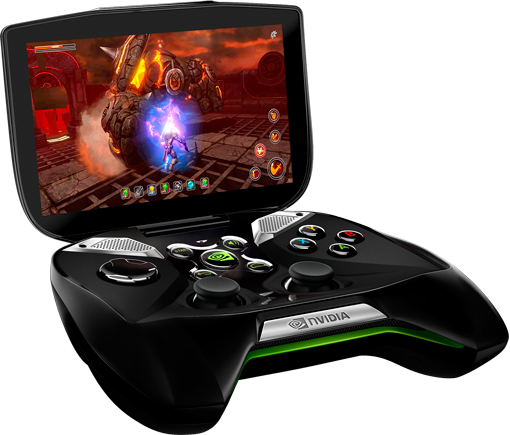
NVIDIA has just recently announced the successor to the company's successful SoC, the Tegra 3, at CES 2013. The new NVIDIA Tegra 4, codenamed 'Wayne', is certainly a very promising SoC, and is expected to push the performance envelope for mobile performance much further. Aside from the SoC, NVIDIA has also announced its first 3G/4G modem, to be used together with the Tegra 4, the Icera i500. To wrap it up, NVIDIA also announced its first ever handheld console, the Project SHIELD, which, apart from introducing a very original and unusual form factor, is also the first handheld console to be able to stream game content from a PC with a GeForce GTX 600 series GPU (or later, I presume). Yes, that means Black Ops 2 on a 5" device. SHIELD can also be used to play games streamed from a cloud game service provider, with the GeForce GRID technology. NVIDIA has announced a real lot of stuff at CES 2013, so let's break it down in pieces, starting with Project SHIELD.


In terms of design, Project SHIELD is basically a traditional videogame controller with a 5" display attached in front of it. The display resolution is 1280 x 720 (16:9 aspect ratio), which means that the pixel density should be roughly around the 300ppi range, which is actually very good. Fortunately, the handheld console will have expandable storage with a microSD card slot, and it also has a microHDMI output, for up to 4K display output. there is also a microUSB port on the device, for connecting to a PC and other devices. A 3.5mm audio jack will also be included, for connecting headphones, and, apart from Wi-Fi, connectivity options for SHIELD include Miracast. NVIDIA says that Project SHIELD is running "pure Android", which presumably means that we'll see completely stock Android OS, without any OEM customizations.

SHIELD can actually also act as any normal android device, given that it runs the full Android OS. NVIDIA's TegraZone app distinguishes itself by displaying games specifically optimized and enhanced for NVIDIA hardware, and hence improving (at least visual) gaming experience compared to its competitors. TegraZone will now also contain games that are specifically enhanced for the SHIELD.

NVIDIA is also using an app, similar to splashtop, to enable streaming of content from GeForce containing PCs to the SHIELD. This will be only possible if you have a GeForce GTX 600 series GPU, and, as I assume, all future iterations of the GeForce series. This can be very helpful for gaming on the SHIELD, because, like in splashtop, what happens is that all rendering is done by the PC's graphics card, streamed to the SHIELD, where the display is mirrored from the PC to the SHIELD. This means that you'll be able to play some very advanced games on the SHIELD, actually, pretty much any PC game can be played from the SHIELD. How would you like to play Black Ops 2 on the SHIELD? Like any other Android device, the SHIELD can also stream games from cloud-based gaming services, which should also be nice.

NVIDIA says that the SHIELD will be released in Q2 2013, and its pricing will be competitive compared to existing handheld consoles and tablets.

Of course, one of the main ingredients for good gaming experience is performance. Given that the SHIELD is intended for gaming, NVIDIA needed to optimize the gaming experience with some excellent performance, while keeping power consumption low enough for mobile standards. Well, considering that the SHIELD will be powered by the brand new NVIDIA Tegra 4 SoC, I'd say that performance won't be a concern or a limitation for the SHIELD.


The NVIDIA Tegra 4 is by far the largest leap the Tegra series has ever made. For starters, it fortunately optimizes thermals and improves power efficiency dramatically by moving from Tegra 3's (and 2's) 40nm process to a much more current 28nm HPL (28nm Low Power with High-K + Metal Gates). NVIDIA recycled and updated the 4-PLUS-1 CPU architecture used in Tegra 3. The CPU gets a very big architecture upgrade from the last-gen Tegra, since the CPU moves from a quad-core Cortex-A9 design to a much more efficient quad-core Cortex-A15 design. The companion core, which is a low power core, optimized for handling light workloads using very little battery, is now another regular Cortex-A15 core, just with very limited clock speeds. Clock speed also receives a bump, and is now up to an impressive 1.9GHz. The companion core is completely invisible to the OS and Apllications. NVIDIA also finally decided to make an acceptable memory interface, this time opting for a maximum of two 32-bit DDR3L channels, on par with the Samsung Exynos 5250 and the Apple A6X. 

The GPU on the Tegra 4 is what gets the biggest bump. We still don't have any details on GPU architecture, but what we know is that the GPU core will consist of 72 shader cores, up from 12 cores in the Tegra 3. This is quite an impressive bump, and without any architecture and clock speed modifications since the Tegra 3, should result in 72 GFLOPS peak theoretical performance, almost certainly better than the Mali-T604 in the Exynos 5250 and almost on par with the Apple A6X's 77 GFLOPS capable PowerVR SGX554MP4 GPU (a little bump in clock rate would easily get the Tegra 4 past the A6X, and that is if the architecture remains unchanged). The new SoC will also enable for output to 4K displays, or output of 1080p content @ 120Hz, and will also enable for 1440p (2560 x 1440) video decode. Taking pictures will also improve a lot with the Tegra 4, given that the chip's ISP (Image Signal Processor) will use Super Speed Imaging to dramatically improve picture-taking. 

For the first time in Tegra history, the new Tegra 4 will be able to be implemented with an Icera i500 Soft Modem, owned by NVIDIA, which will finally enable for Tegra 4 to be used in 3G/4G LTE enabled devices. Looks like Qualcomm has just lost its major selling point. At any rate, we shall soon see how this amazing looking SoC fares among the existing SoC competition, and we'll see whether it survives the onslaught of competition arising together with it. 

terça-feira, 18 de dezembro de 2012

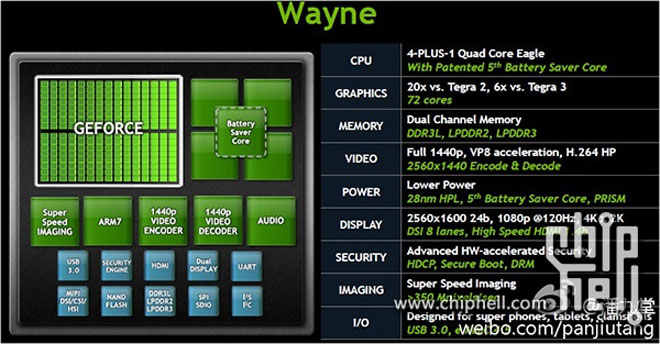
NVIDIA Tegra 4 'Wayne' specs leaked: 28nm, Quad-core Cortex-A15, 72 core GPU, and more


With NVIDIA's Tegra 3 'Kal-El' getting very out-dated, it was about time NVIDIA released their upcoming SoC, the Tegra 4, codenamed Wayne, and once again NVIDIA has amazed us with the specs of their next-gen SoC. Wayne (finally) is NVIDIA's solution to some serious performance and efficiency flaws present on Tegra 3.

First up is the CPU. NVIDIA has made some nice success with it's 4-PLUS-1 CPU architecture, introduced in Tegra 3. As a quad-core processor is expected to consume a lot of power, NVIDIA has used vSMP (variable symmetric multiprocessing) to couple those four high performance cores with one power saver core, which is optimized for very low performance, and therefore very low power consumption, and is made for handling light tasks. When the CPU's workload is low, for example, when the device's screen is off, or when a video is being played, the four main cores can be power gated, and all processing is transferred to the fifth power saver core, until such time when the workload increases. This dramatically increased the battery life that Tegra 3 devices could offer. 4-PLUS-1 is very similar to ARM's big.LITTLE concept. Since this technology has benefited NVIDIA greatly, 4-PLUS-1 carries on to the Tegra 4. Power saver core aside, the Tegra 4 will have four state of the art ARM Cortex-A15 cores. This means a serious amount of processing power. The Google Nexus 10's CPU has two Cortex-A15 cores, and yet it has by far the best performance in any mobile device. Based on that, we can assume that Wayne will really be revolutionary to mobile CPU performance. Not to mention that previous leaks suggest that Wayne will run at clock rates even larger than that of the Nexus 10's CPU, pushing the performance envelope even further.

Another impressive feature of Tegra 4 is the GPU, which isn't a surprise, considering NVIDIA is the leading PC GPU company. NVIDIA is promising 6 times the performance of the Tegra 3's GPU, and twenty times the power of Tegra 2. While the Tegra 3 has 12 GPU cores, Wayne's GeForce GPU will have an impressive 72 GPU cores, which, at the Tegra 3's clock rates, results in a total of 72 GFLOPS performance, which is close enough to the 77 GFLOPS the PowerVR SGX554MP4 in the iPad 4 can do, and should also beat by far the current Android GPU king, the Mali-T604 inside the Nexus 10. Hopefully, NVIDIA was smart enough to use an unified shader architecture for this GPU, and discarded the very dated discrete shader architecture in the Tegra 3. Previous leaks had indicated that Wayne's GPU would be built on NVIDIA Kepler technology. Despite being a very exciting prospect, these leaked specs don't mention Kepler at all. It also doesn't mention whether Wayne will support CUDA.

One feature that has always been crappy in the Tegra series, and has always seriously bottlenecked performance, is memory bandwidth. While pretty much every other SoC manufacturer was using dual-channel configurations for their memory controllers, Tegras 2 & 3 sticked to a very weak single-channel memory interface. Thankfully, NVIDIA has fixed that with Wayne, for the SoC will support dual-channel memory controllers from LPDDR2 to DDR3L. On the best case scenario, that is, dual-channel DDR3L, the Tegra 4 should have memory bandwidth close enough or equal to the Nexus 10's Exynos 5250 chip and the iPad 4's Apple A6X chip. It's good to see that NVIDIA has finally done away with one of Tegra's main bottlenecks for performance.

It looks like NVIDIA is also pushing the ISP (Image Signal Processor) envelope with Tegra 4 too. The leak shows that Wayne will have Super Speed Imaging, which will allow for more than 350 Mpixels/sec ISP speed. It also seems like Tegra 4's display output capability also improved. Not only does the SoC allow for high resolution 2560 x 1600 displays, it also can output to 1080p displays at a sweet 120Hz refresh rate. Impressive enough, but that's not all. Tegra 4 can even output 4K display resolutions.

To wrap it up, NVIDIA is also offering some advantages also in terms of thermals and power consumption, by making the move to a 28nm process. This is a big advancement for Tegra, considering that the last-gen Tegra 3 was built on 40nm process, the move to 28nm is quite a leap.

NVIDIA's Tegra 4 'Wayne' is going to be officially announced in Janurary 2013, at CES (Consumer Electronics Show), and then, hopefully it won't be long before we see this amazing new SoC inside an actual device.